captain_70s Posted March 29 Posted March 29 I had a peer through the "library" and found this, which may or may not be useful! Matty, Westbay, GeorgeB and 3 others 6
Paul-l Posted March 30 Author Posted March 30 9 hours ago, captain_70s said: I had a peer through the "library" and found this, which may or may not be useful! Now that’s the kind of book that’s really useful GeorgeB and Westbay 2
captain_70s Posted March 30 Posted March 30 1 hour ago, Paul-l said: Now that’s the kind of book that’s really useful I think I have 4 volumes, circa 1940. Inherited from my Grandad who was a mechanic in the 1960s and was probably working on a lot of old crocks. Ironically I've never owned anything remotely old enough to be referenced!
Mr Pastry Posted March 30 Posted March 30 8 hours ago, High Jetter said: Maybe @Mr Pastry's area of expertise? That is indeed a very useful book, I have a set of those somewhere. Can't add much to what it says but essentially, if the battery is going flat , assuming the cutout relay is working, then you advance the third brush to increase charging rate, But if the battery is getting fried then you retard the third brush to reduce it, as per the car's ammeter. That is it, basically, but if you do a lot of driving with the lights on, then the rate needs to be set higher. It's a bit hard on the battery, hence why a proper regulator is better. The driver's handbook for the Austin, if available, will probably have specific instructions. Some cars had a switchable field resistance to provide high/low charge rate. I'd have thought nowadays you could just drive with the lights on all the time, and set the charge rate to suit, but it would not be difficult to fit a regulator. High Jetter, Westbay and GeorgeB 3
Paul-l Posted March 30 Author Posted March 30 11 hours ago, Mr Pastry said: It's a bit hard on the battery, hence why a proper regulator is better. The driver's handbook for the Austin, if available, will probably have specific instructions. Some cars had a switchable field resistance to provide high/low charge rate. I'd have thought nowadays you could just drive with the lights on all the time, and set the charge rate to suit, but it would not be difficult to fit a regulator Thanks. The handbook doesn’t mention adjusting the brush position, but it does have a half and full charge switch. The problem is that it makes no difference - the ammeter is pinned on the maximum of 16 A most of the time while driving, so what it’s actually generating I don’t know. From what I can see / guess the field resistance is hidden in the dynamo case and may have become shorted out so the switch makes no difference. Any idea what the resistance should be? it looks like I’m going to have to drive with the lights on to give the battery a rest. I am a bit concerned that it is going to cause the dynamo to burn its coils out. long term I think I’ll have to convert it to a two brush and add a regulator but was hoping to get a years use out of it before diving too deep.
Mr Pastry Posted March 30 Posted March 30 11 hours ago, Paul-l said: Any idea what the resistance should be? Not offhand, but I will see if I have any info. About 3 ohms? Perhaps more likely to go open circuit than short, so possibly a switch or wiring fault?
Paul-l Posted April 12 Author Posted April 12 More fiddling with the dynamo has happened, so here’s some spot the difference pics. well the second picture has the third brush a bit more advanced giving around 12A less charge, and a noticeable difference in the two charge rates. It turns out that the charging rate is very sensitive to the third brush position - any more advanced than that and the dynamo won’t charge on the low setting at all. Datsuncog, captain_70s and Matty 3
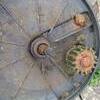
Paul-l Posted April 22 Author Posted April 22 I mentioned that the run up to Rustival and back was slightly marred by a bit of vibration. It felt very much like unbalanced wheels, but couldn’t be. It varied with road speed, got worse with speed, was independent of gear, and went away almost completely on the over run. So after ponderin we decided it must either be the the prop shaft or rear axle. there was also a squeak near the middle of the car at low speed. with a four hour drive there’s plenty of time to ponder the problem in between stopping to close the bonnet again! Best look at the easy stuff first - loose bolts, but nothing completely obvious. But there was a slight bit of movement at the fabric coupling when wiggling with the handbrake on. spinning the shaft around with the handbrake off showed much more - the shield around the coupling was moving in and out and squeaking as it moved. Pulling the shaft off showed the coupling was really very loose. One of the bolts wasn’t attached to the brake drum at all, and the other two just span when I tried to remove the coupling nuts. Luckily the bolts weren’t screwed into the drum, but had nuts on the back between it and the gearbox. Once I got a spanner on them they came out quickly. The one without a nut on came out even quicker! the coupling itself is in good condition , but the bolts aren’t happy with most of the thread being worn off. It looks like one of the tab washers had failed letting one nut fly off. This had then vibrated the other nuts a bit loose and knackered all three bolts. hmmm RayMK, High Jetter, Matty and 3 others 6
Asimo Posted April 23 Posted April 23 I think you got to that just in time! Westbay, jim89, Matty and 1 other 3 1

Recommended Posts
Create an account or sign in to comment
You need to be a member in order to leave a comment
Create an account
Sign up for a new account in our community. It's easy!
Register a new accountSign in
Already have an account? Sign in here.
Sign In Now